

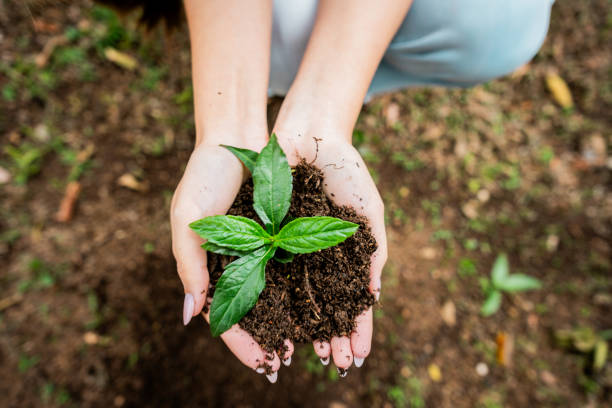
Healthy soil is the foundation of food security and a key element in counteracting the effects of climate change.
It is worth having knowledge and awareness of the interactions in this area so that we can effectively conserve natural soil resources so that they can serve future generations.
Climate change has a significant impact on soil health, meaning its ability to support biological life, store water and nutrients, and provide suitable conditions for plant growth. Soil is not only the basis for food production but also a key element of ecosystems, and its quality is largely dependent on climatic factors. In this context, rising temperatures and changing rainfall patterns are crucial, as these factors determine the intensity and direction of biological and chemical processes in the soil. High temperatures can accelerate the decomposition of organic matter, which may initially increase nutrient availability, but over time leads to soil sterilization and a decrease in humus content. In turn, prolonged droughts or heavy rainfall can cause erosion, structural damage, reduced water retention, and nutrient leaching. These are the first symptoms of soil degradation, meaning a reduction and limitation of soil functionality as an integral element of the ecosystem. These changes have the greatest impact on the agricultural sector, reflected in reduced crop production in both quantity and quality. However, the broader significance of this negative phenomenon, expressed through disruptions in soil's ability to sequester carbon, leading to increased CO₂ emissions into the atmosphere, is increasingly being emphasized. The loss of organic matter from soil not only reduces soil fertility but also creates a feedback loop that can exacerbate global warming. In addition to changes in the physicochemical and chemical properties of soils, soil microbiological activity is significantly and significantly modified. Soil microorganisms are extremely sensitive to changes in humidity and temperature – extreme conditions can lead to a decrease in their diversity and activity, which directly impacts the soil's ability to self-purify, fix nitrogen, and decompose organic residues.
In light of such climate change, a number of measures should be taken to maintain soil health and mitigate its negative effects. Among the many proposals, the importance of sustainable agricultural practices should be emphasized, such as no-tillage, crop rotation with legumes, and the use of organic fertilizers. Increasing humus content plays a significant role, which can be achieved through composting, mulching, or sowing cover crops. This practice also contributes to strengthening soil structure, maintaining proper water-air relations, enhancing water retention, and protecting soils from erosion.
These topics will be discussed by speakers at the 7th EUROSOIL 2025 (September 8-12 in Seville, Spain): https://eurosoil2025.eu/EUROSOIL2025/welcome
More information on the above can also be found on the official website of:
- The International Union of Soil Sciences (IUSS): https://www.iuss.org/
- FAO "Status of the World's Soil Resources"
- IPCC (AR6 WG2): https://www.ipcc.ch/report/ar6/wg2/